


The World of Water (WOW) charity is embarking on an ambitious journey to bring the vital importance of water to the forefront of public consciousness.


At the heart of this initiative are two of our esteemed trustees, both hailing from the world of design. Their expertise brings a unique perspective to our exhibitions, ensuring that each installation is not only informative but also visually stunning and emotionally impactful.
By leveraging their creative prowess, we’re able to craft experiences that resonate with visitors on multiple levels, fostering a deeper understanding and appreciation for water’s multifaceted nature
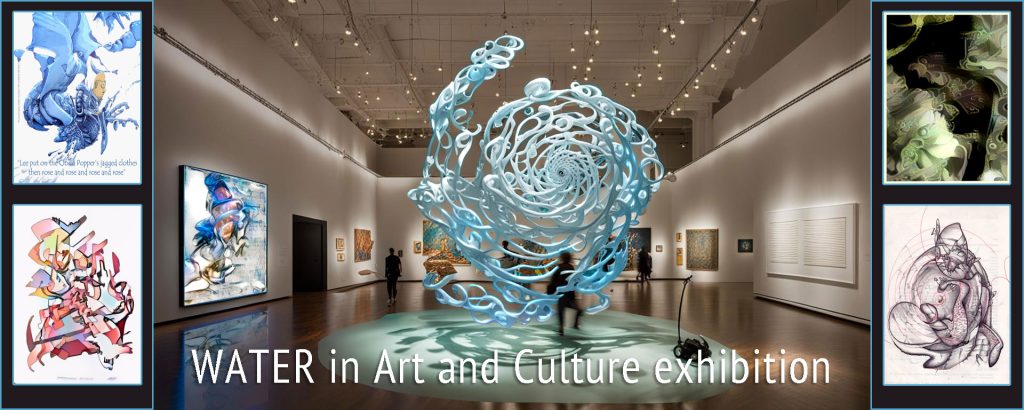
The fusion of scientific knowledge and artistic vision allows us to present complex water-related issues in accessible and engaging ways. From interactive displays to thought-provoking art installations, our exhibitions promise to be a feast for the senses as well as the mind.

In light of this exciting venture, we’re pleased to share a transcript of a rare interview podcast with Grant, one of our design-savvy trustees, discussing his innovative approach to exhibition design. (We hope to upload a copy of the original recording to this page soon, offering visitors an auditory glimpse into the creative process behind our upcoming water-themed exhibitions.)
Interview Transcript:
Host:
 Welcome to our Late Night Lounge. Today we're joined by Grant, who's design skills have been used by art studios, architects, marketing groups, PR companies, videographers, visitor centres, museums - the list goes on. But in this podcast, we're hoping to learn something about what drives Grant, his early influences, and his unique client-involving methods. So welcome to our Late Night Lounge Grant and thanks so much for being here.
Grant:
Thanks for having me! I'm always excited to talk about design - and water too.

Host:
That gives me the opportunity of saying 'let's dive in!' But before we talk about your International Water Awareness Corpus, my producer mentioned to me that you rarely give interviews. What's the reason for that?

Grant:
I think most interviews are peppered with too a light dusting of entertainment rather than being well seasoned with unfathomable wonder, and another thing; whenever I'm interviewed my thoughts shift to all the things I should be doing. But not today - for the moment. You have my full attention - that's up to the point I bring out my pencils and drawing pad and start sketching bigger and better Late Night Studio designs for you.

Host:
Perhaps you can design something for us later but to start, could you tell our listeners a bit about what drew you to design in the first place?

Grant:
When young, the family house in London was always packed with photographs and photo developing equipment. My dad was a Fleet Street photo journalist. We'd spend hours designing fonts together for his book jacket designs rather that playing catch and he'd draft Dr. Who and the Dalek scenes in perfect perspective. As a fan of Dr. Who, it made it impossible to resist the draw of it all - particulary those coloured crayons!

Host: With this immersion in a world of visual imagery from a young age, do you think all your father's work shaped your perspective on design in some way?

Grant:
In lots of ways. I saw a lot of images, and in them, a lot of joy, pain and hardship. He was a WWII photographer on reconnaissance missions so knew exactly how to get in close to his subject. My view of reality came from a global image source and it was right on my doorstep everywhere I looked.

That world was not something my school exposed me to and my perspective on adult life was stretched very early on. But my dad was also a technition. He'd studied electronics and his drawings were very detailed, as were his book jacket designs - always aligning text; "busy tweeking his kernings and leadings" as my mum would say.

He taught me to draw in perspective when I was 6, and as soon as you can do that, the page, every page, every painting and shadow layer gains an extra depth as you draw and it pulls you in real time. But if any shapeing was happening I didn't see it at the time as my love was for the shape and form of sea shells.

Host:
That's a unique blend of raw skills. Your mention of sea shells is intriguing. How did your fascination with sea shells influence your approach to design later in your career? I've seen some of your recent architectural and exhibition designs but were you initially drawn to more to natural flowing forms in your work, or did you lean towards the precision your father taught you from the start?

Grant:
 I think I was conditioned to see detail right from the start. On trips to the beach, I'd be the child exploring the fine sand particles with a magnifying glass to find the miniature abandoned houses of shellfish that didn't quite make it to adulthood.

Rockpools were worlds within worlds. Seaweeds, a blanket protecting habitats that most beach lovers trod under foot on their race to secure the latest ice cream flavour. Nature was absolutely my top designer. Natural forms takes some beating!

Host:
Let's save that topic for another interview. Your description paints a vivid picture of a child with an extraordinary eye for detail and a deep appreciation for the intricacies of Nature.

Given your admiration for Nature as the ultimate designer, how do you incorporate these organic, natural forms into your work today, and are there specific projects or designs where you feel you've successfully captured the essence of what you observed in those rockpools and seashells?

Grant:
With a rather sad heart, I recognize that we live in a very modular world. A playground of bricks, blocks and pixels. When young I experienced this very restrictive world too of course - having had lego and meccano as toys.

I find my freedom from this modular constraint comes when I have a pencil and many sheets of blank paper in front of me at an initial design meeting with a client. These early stages of design are full of freehand sketching and sometimes, hundreds of aspect-designs are created and discussed - all left with clients to digest. So these free-wheeling sessions are my whirlpool moments and I get my clients to sort out what rocks with them.
Subsequent meetings are to define structure and to engage the full team of builders, makers and users.

I think the only time I hold the entire design process inhouse, is when I need to communicate, from the start of a project, in a near to finished manner; then, I'll produce realistic visuals, maquettes, screen views, audio demos, scale models and UX designs.

Host:
Does leaving clients with hundreds of aspect-designs impact their satisfaction and sense of ownership over the final design?

Grant:
You have to remember that your client already knows what they are trying to achieve. They need a practical designer on their team, and, it is always THEIR team, their project, their aim. I'm coming in as a translator, visualiser, a materialiser, a futurist and sometimes a mind-reader.

Because,the biggest nightmare for a designer is having a client who says "I'll know what I want when I see it". That usually means they like shopping of the shelf so they may as well do that and use their time to browse design search libraries. If they find something they like, it will already have an owner so it's just a matter of agreeing 'how much'. That's trading. And before you say it, I do accept that some designer will have worked on whatever they find, but I focus on solution design more than shelf-filling design. Having said that, I do have a new client who only wants me for my brand design skills!

Design is all about 'getting it right' and when it is right, it's good design. Creativity on the other hand can be purely an art. There's a balance between being too creative and being too practical. We all know buildings which have been designed for their look rather than their practical qualities.

Host:
Who determines the end result in design projects?

Grant:
Let's just say that very few designers, if any, escape getting emails which start with, "further to our design meeting, we've had a discussion with our accountants and .... ". These emails are common at the breakfast tables of most designers. Setting a budget at the start helps avoid this. Not always.

Host:
So what sort of design projects do you pursue purely for the love of design? And do these involve you in navigating very different budget constraints?

Grant:
When you find me tackling projects inhouse, it's the love of doing them that funds me. I have a workshop, digital studio and drawing office, so I can often turn projects around at speed if a client knows exactly what they require.

Host:
How do you guide clients with an uncertain vision and budget constraints?

Grant:
The value of time is greater than money - the latter you can print more of when you want it. The former runs out within just one lifetime. If clients feel uncertain I get them to create an online picture wall on instagram. That takes up their time but it pulls them into their project in a way it can be shared with the team. At the onset, dream. We can achieve results.

Those results will still be results. No matter what budget you use on them, you will have results and I believe that's like learning to walk - we all start gradually, some run, some sprint, some make giant leaps for mankind.

Host:
Your approach to design and client relationships is truly unique and insightful. I'm particularly struck by your philosophy on time and how you engage clients in the creative process.

Using Instagram as a collaborative tool for clients to create a picture wall is a brilliant way to get them invested in their own project and I'd really like to discuss how this method evolved your client relationships over time but were pushed for time. So let me ask you two final questions if I may.

Firstly, it seems you're advocating for a step-by-step approach that can adapt to various budget constraints while still delivering meaningful outcomes. How do you help clients understand and appreciate this philosophy, especially when they might be fixated on grandiose visions?

And lastly, your mention of projects making "giant leaps for mankind" is intriguing. Without naming names, could you share a bit about the nature of these projects that truly ignite your passion and what sets them apart from your other work?

Grant:
One day I'll design a clock with a time-expansion facility but for now, let me just say these few things.

Firstly, you invited me here to talk about the International Water Awareness Corpus so I accepted your invitation. Had it been just about my design work you wouldn't have got this interview.

Secondly, I don't mind but your producer might, as you've missed a World scoop.

And thirdly, let me answer your closing questions by saying that specialist designers are engaged for their expertise, while draughtsmen are hired to create detailed design drawings. Picture or idea walls are a bridge I can walk along to meet some clients but, they are a pool for the client team to swim in. And if the client swims with their entire team at the same time, I rarely need to step into the water to discuss budget constraints. They already know. It's inhouse.

There are dreamers with grandiose visions and I can help present these - which in turn leads to them being better understood ... which increases the chances of them being funded and actioned.

And visionary people with passion often have good communication skills, but by adding a specialist designer's skills, their vision can go viral and ignite interest globally in minutes. Something sets successful visionaries apart - they all use Excellent Designers.

Host:
Thank you Grant for sharing your insights and experiences with us today. It’s clear that your approach to design is not only about aesthetics but also about fostering collaboration and amplifying visionary ideas.

Your belief in the power of design to transform concepts into impactful realities is truly inspiring.

We appreciate your time and look forward to hearing more about how your work continues to ignite interest and drive innovation in the design world. I'll make sure we put a link to your work on the International Water Awareness Corpus on our website. Sorry about that but I got carried away with your design approach.

Join me in the Late Night Lounge again next Friday when we discover what's happening in the Land of Sounds.

And here that link to the International Water Awareness Corpus

Conclusion and Call to Action
As we prepare to launch our series of exhibitions, we invite you to celebrate and protect our planet’s most vital resource: water. Each exhibition will highlight water’s beauty and significance while inspiring action on conservation challenges.
Stay connected through our website and social media for updates on dates, locations, and ways to get involved. Your support is essential in spreading awareness about water’s critical role in our lives.
Thank you for joining us on this mission. Together, we can make a meaningful impact and foster a deeper understanding of water’s importance in our world.
We look forward to seeing you at our exhibitions!