


Water in Measurement
Water, often seen simply as a vital resource, has played an equally important role in measuring and understanding our world. From ancient river markers and water clocks to hydraulic computers, laboratory instruments and satellite sensors, water has helped people measure time, distance, volume, temperature, pressure, rainfall and much more.
But there is an even more curious story here. Water has not only been something we measure. It has also become a measuring reference, a mathematical medium and even a model for things that have nothing physically to do with water.
Follow that story from the ancient Nile to the modern planet and measurement begins to look rather different.
The Ancient Foundations: Nilometers and Clepsydras
Our story begins in ancient Egypt, where the Nile was not simply a lifeline but also a way of reading the changing world around it.
Nilometers were used to monitor the annual rise and fall of the river. Some of the earliest forms were probably simple marks or graduated features on the banks, while later examples became carefully constructed wells, shafts, stairs and columns with calibrated scales. Their readings helped anticipate the extent of the annual inundation, with consequences for agriculture, taxation and food supplies.
One of the best-known surviving examples is on Elephantine Island at Aswan, where a staircase descends towards the river and carries markings recording different water levels. Another is the famous nilometer on Roda Island in Cairo, completed in 715 CE. Its measuring well was connected to the Nile through tunnels, allowing the changing river level to be read against a graduated marble column.
These were far more than instruments for measuring water. A Nile reading could become an indication of what was likely to happen to crops, food prices and government revenue. In that sense, water level became an early indicator of wider economic conditions.
The practical importance of nilometers declined as modern river control and dam construction changed the Nile’s natural flow, particularly after the construction of the Aswan High Dam in the 20th century. Yet the principle remains remarkably simple: watch the water and the water tells you something about the wider world.
Meanwhile, the clepsydra, or water clock, turned water flow into a measure of time. By allowing water to enter or leave a vessel at a controlled rate, a changing water level could be related to the passing of hours. Water clocks were used in ancient Egypt and in other cultures, and became increasingly sophisticated.
Here water was no longer simply a thing to be observed. Its movement had become a way of measuring something otherwise invisible: time.
Water as a Measuring Stick
The principle behind some of the simplest forms of measurement is wonderfully physical. A still body of water settles to a horizontal surface, so water can provide a natural reference for establishing level.
Long before the modern spirit level, water-filled vessels and channels could be used for levelling. Surveyors and builders could compare water surfaces, or use a vessel of water as a horizontal reference, to determine whether a surface or line was truly level. Later, in the 17th century, the development of the bubble or spirit level turned the same gravitational principle into a compact instrument. Modern spirit levels normally contain alcohol or another liquid rather than water, but the underlying idea remains familiar: a liquid and a bubble reveal which way is level.
Water also became part of the history of temperature measurement. Early thermoscopes used changes associated with temperature to make heat and cold visible through the movement of a liquid column. These early instruments eventually evolved into calibrated thermometers. Water was therefore helping people measure not just its own level, but position, temperature and change.
Another ingenious instrument turned water into a reference against which other liquids could be measured. The hydrometer floats at different depths according to the density of the liquid around it. Because the density of water provides a convenient reference, hydrometers became useful in chemistry, brewing, distilling and industry. In Britain, the Sikes hydrometer was adopted officially in 1816 for determining the strength of spirituous liquors for excise purposes.
The idea is deceptively simple: the water is not necessarily the thing being measured. It provides the yardstick.
Ingenious Water Management: From Floats to Aqueducts
As civilisations advanced, so did their methods of measuring and controlling water.
One simple but important principle was the float. A float rises and falls with a changing water level and can be connected to a rod, lever, pointer or other mechanism. Something that cannot be seen directly — a changing quantity of water — is converted into movement that can be observed, recorded or used to trigger another process.
The principle eventually became part of automatic controls, gauges and monitoring systems. It is still found in surprisingly ordinary devices, from tanks and cisterns to industrial systems.
The Romans developed sophisticated ways of measuring, transporting and distributing water. Their aqueducts depended on careful control of gradients, flow and elevation, while distribution networks required some means of assessing how much water was being delivered.
One Roman unit was the quinaria, used in connection with the measurement and distribution of water. Frontinus, the Roman official who wrote about Rome’s water supply around 100 CE, discusses different interpretations of the unit and describes standardised pipe or ajutage dimensions. The most probable explanation he records gives the quinaria a diameter of five quarters of a Roman digit.
The important point is not the exact conversion into a modern unit. It is that the Romans were attempting to turn flowing water into a standard, measurable quantity that could be managed across a large infrastructure.
Archimedes and the Measurement of Volume
Around the 3rd century BCE, the Greek mathematician and engineer Archimedes of Syracuse, who lived approximately 287–212 BCE, explored the relationship between water displacement and volume.
The familiar story of Archimedes and the bath may be surrounded by later legend, but the underlying physical principle is fundamental.
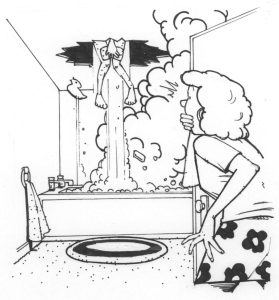
An object immersed in water displaces an amount of water corresponding to its volume below the surface. Measuring that displacement provides a way of determining the volume of an irregular object that would be difficult to measure directly.
The principle became enormously important in science and engineering.
Here again, water becomes a measuring medium. Something solid is measured by what the water does in response to it.
Rain, Pressure and the Changing Environment
Water can also be measured as it arrives from the sky.
A rain gauge is an extraordinarily simple instrument: collect rainfall over a known area and measure the depth of water collected. Yet that simple measurement has enormous practical value. Rainfall records help farmers understand growing conditions, meteorologists monitor weather systems, and hydrologists assess droughts, floods and water availability.
Modern meteorological networks may use automated tipping-bucket gauges and other sensors, but the essential question remains the same: how much water has fallen here?
Another change in water’s state creates another measurable quantity. Heat water and it becomes steam; steam can exert pressure; pressure can then be measured.
Steam engines therefore required instruments capable of monitoring pressure and vacuum. Early steam gauges used liquid columns, while later mechanical gauges made pressure easier to read directly. Water, through its transformation into steam, had become part of a new measurement system essential to industrial technology.
The principle even entered the home. The pressure cooker uses the relationship between water, steam and pressure to raise the boiling point and cook food at a higher temperature than would otherwise be possible.
One cubic metre of water provides another useful reminder of how measurements can change our understanding of scale:
A cubic metre of water has a mass of roughly one tonne.
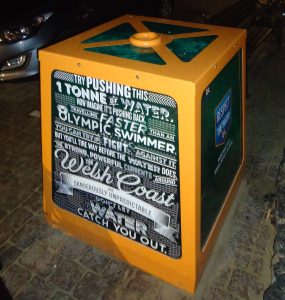
A number such as 1,000 litres can seem abstract. A tonne of water is much easier to imagine. This simple relationship links the same substance to household consumption, reservoirs, agriculture, industry, transport and engineering.
Water Becomes a Computer
Long before computers became electronic, water itself could be used to perform calculations.
In 1936, Soviet engineer Vladimir Lukyanov developed a hydraulic integrator in which water flowing through interconnected pipes and vessels represented mathematical quantities and relationships. His work arose from an engineering problem: understanding temperature changes in concrete structures. The hydraulic system could solve complex partial differential equations by exploiting an analogy between the movement of water and the movement of heat.
Instead of calculating every stage by hand, the machine allowed physical processes to represent the mathematics.
Water was now doing something extraordinary.
It was calculating.
And a little over a decade later, water was used to model something even less tangible.
In 1949, New Zealand-born engineer and economist Bill Phillips developed the MONIAC [the Monetary National Income Analogue Computer], at the London School of Economics. Coloured water represented money flowing through an economy. Tanks and pipes modelled relationships involving income, taxation, government spending, saving, investment, imports and exports. Valves could be adjusted and the resulting changes in the flow of water could be observed.
The machine was designed to demonstrate the circular flow of money through an economy. Approximately fourteen MONIACs were built, and surviving examples include the Science Museum in London and the University of Melbourne. The Reserve Bank of New Zealand has an operational MONIAC and describes it as the only operational example in the Southern Hemisphere that it is aware of.
The MONIAC is remarkable because it changes the meaning of the whole subject.
Water is no longer the quantity being measured. It is not even simply the instrument doing the calculation.
Water has become a physical language for representing something else.
An abstract economic relationship – difficult to see directly, could become visible as the movement of coloured water through pipes and tanks.
The Scientific Revolution: Measurement Becomes More Precise
During the Scientific Revolution and the centuries that followed, instruments for measuring water became increasingly precise.
Water-level gauges using floats, rods, chains and pulleys allowed changing levels in wells, reservoirs and other storage systems to be monitored. Calibrated instruments made it possible to compare observations over time and between different places.
These developments were part of a much larger change in science. Measurement increasingly meant not merely observing something but assigning it a reproducible quantity.
Water became part of that process at almost every level – from measuring the volume of an object by displacement to using a column of liquid to indicate pressure or temperature.
Su Song: Water and the Measurement of the Heavens
Water’s role in precision machinery was not confined to Europe.
In 1088 CE, the Chinese polymath Su Song completed a remarkable astronomical clock tower whose mechanisms were driven by a water-powered escapement system. Water was used to regulate the movement of the machinery that operated the clock and astronomical displays.
The machine demonstrates another important feature of water as a technology: it does not have to be the final object of measurement. Its controlled movement can provide the regularity needed to operate a much larger system.
Water could measure time.
Water could drive the mechanism that measures time.
And now water could help instruments track the movements of the heavens.
Leonardo da Vinci and the Study of Moving Water
By the late 15th and early 16th centuries, Leonardo da Vinci was making detailed observations of water flow, turbulence, eddies, waves and channels.
His notebooks contain drawings and investigations of water in motion. He was fascinated by the behaviour of flowing water and repeatedly returned to the subject, seeking to understand the physical principles behind what he observed.

His work belongs to a long transition from simply recording what happens to investigating why it happens.
Measurement becomes more powerful when it is joined to observation, experiment and explanation.
From Instruments to Sensors and Satellites
Today, water measurement has become both more precise and vastly larger in scale.
Sensors can measure water level, temperature, pressure, flow, electrical conductivity and aspects of water chemistry. Simple test strips can reveal properties such as pH or chlorine concentration that cannot reliably be judged by sight alone.
A farmer does not necessarily need to water a field simply because the surface looks dry. Soil-moisture sensors can help determine how much water is actually present below the surface. Satellite systems can extend this principle over huge areas, using remote sensing to map soil moisture, surface water, vegetation and other indicators that help guide irrigation and water management. (See: Water in Farming)
The scale has changed dramatically, but the underlying principle has not.
Measure first. Then act on what the measurement tells you.
Water’s Role in Monitoring Our Planet

Accurate water measurement is now essential to understanding changes taking place across the planet.
We can measure the changing levels of rivers and reservoirs, the amount of rainfall entering a catchment, groundwater levels in aquifers, soil moisture, sea-surface temperatures and the changing extent of glaciers and ice sheets.
Measurements of ice and glacier loss contribute to our understanding of sea-level change. Ocean measurements help reveal the movement and redistribution of heat. Groundwater measurements tell us about resources that may be invisible beneath our feet.
These observations create records that can be compared across years and decades.
Water, in its many forms — river, rain, ice, ocean, soil moisture and groundwater — has therefore become one of the great indicators of environmental change.
And the more closely we measure it, the more the measurements reveal about the world around it.
What Water Has Taught Us to Measure
The history of water in measurement is not really a simple march from ancient instruments to modern technology.
It is a story of expanding relationships.
Water can be the thing being measured: its level, volume, flow, temperature or rainfall.
Water can provide the reference: a horizontal surface for levelling, or a density standard for a hydrometer.
Water can make an invisible quantity visible: a float turns changing level into movement; a liquid column reveals pressure or temperature.
Water can perform a calculation: Lukyanov’s hydraulic integrator used its movement to solve equations.
And water can represent something completely different: Phillips’s MONIAC used flowing coloured water to make the movement of money through an economy visible.
Today, sensors and satellites extend the same journey across whole landscapes and around the planet.
We keep finding new things that water can tell us.
Join Us at the “Water in Measurement” Exhibition
If this exploration of water’s role in measurement has piqued your interest, we invite you to dive deeper through our developing Water in Measurement exhibition.
From ancient nilometers and water clocks to hydrometers, rain gauges, pressure gauges, hydraulic computers and modern sensors, these objects reveal the surprising ways in which water has helped us understand both the physical world and the systems we have built within it.
The exhibition will explore the intersections between science, technology, history and environmental stewardship, and perhaps encourage visitors to look differently at some of the measuring instruments around them.
Your Support Makes Waves
Your support helps us make water education accessible to more people. We welcome contributions to the exhibition, whether through relevant artefacts, knowledge and experiences, practical help or financial support.
Every object can open another door into the story.
And every measurement tells us a little more about the one thing we all share:
One Water.

Doors into the Next Layer of the Story
Science Museum Group — Phillips Economic Analogue Computer (MONIAC)
https://collection.sciencemuseumgroup.org.uk/objects/co64127/phillips-economic-computer-analog-computer
Reserve Bank of New Zealand — MONIAC resources
https://www.rbnz.govt.nz/museum/moniac-resources
University of Melbourne — The MONIAC
https://museumsandcollections.unimelb.edu.au/collections/business_and_commerce/the_moniac
UNESCO — Raoudha Nilometre in Cairo
https://whc.unesco.org/en/tentativelists/1826/
The Metropolitan Museum of Art — Telling Time in Ancient Egypt
https://www.metmuseum.org/essays/telling-time-in-ancient-egypt
The Metropolitan Museum of Art — Clepsydra or Water Clock
https://www.metmuseum.org/art/collection/search/549190
Smithsonian National Museum of American History — Sikes Hydrometer
https://americanhistory.si.edu/collections/object/nmah_1183872
Science Museum Group — Sikes’ Revenue Hydrometer
https://collection.sciencemuseumgroup.org.uk/objects/co12379/sikes-revenue-hydrometer-1816-1873
Met Office — How We Measure Rainfall
https://weather.metoffice.gov.uk/guides/observations/how-we-measure-rainfall
Science Museum Group — Mercurial Pressure Gauge from Beam Engine, 1808
https://collection.sciencemuseumgroup.org.uk/objects/co51652
OpenLearn — Vladimir Lukyanov and the Hydraulic Integrator
https://www.open.edu/openlearncreate/mod/book/tool/print/index.php?chapterid=38448&id=226636
Frontinus, De Aquaeductu Urbis Romae — discussion of the quinaria
https://penelope.uchicago.edu/Thayer/E/Roman/Texts/Frontinus/De_Aquis/Bennett/1*.html