


The Ground Floor of Reading
Why first books should be easier
To have a ‘Year of Reading’ in 2026, or during any other year, is a useful reminder that reading matters. But once the banners have come down and the campaigns have moved on, there is a more fundamental question worth asking, which is, “where does reading actually begin?”
It’s not with a library card. Not with a reading scheme. And not even with a favourite story.
It begins when a child discovers that letter marks, drawn on a page or written with water, can be worked out, turned into sounds, and made to mean something. And then, perhaps almost unnoticed, comes one of those small but important turning points for a child as they think to themselves, “I can read this.” That is their ground floor of reading. It’s their beginning – their seed point of understanding the world around them.
Stories to make this first step achievable
English is not an especially simple language to learn to read. Children eventually have to deal with a large collection of sounds, letters, spelling patterns and exceptions. There is no point pretending otherwise.
But a child learning to ride a bicycle does not begin by being handed every gear, brake setting and maintenance procedure. First comes balance. Then movement. Then confidence. Complexity can follow.
Here at WOW, we’ve always been into live improvised storytelling, but it was chance meeting with the author Julie Ford that made us realise that early reading deserves the same consideration.
A deliberately small reading world
Our charity’s imprint, Little People Books, teamed up with the English Literacy Foundation to create a small enough world in which a beginning reader can experience success. We did this by writing stories using a deliberately restricted set of letters and sounds.
The aim was not to simplify English permanently, but to leave some aspects out ‘for starters’. So, no silent letters. No digraphs. No complicated spelling patterns. No attempt to introduce the whole machinery of English at once. We ended up having to use a small vocabulary but made up for it with larger-than-life stories and illustrations.

Pictures are important.
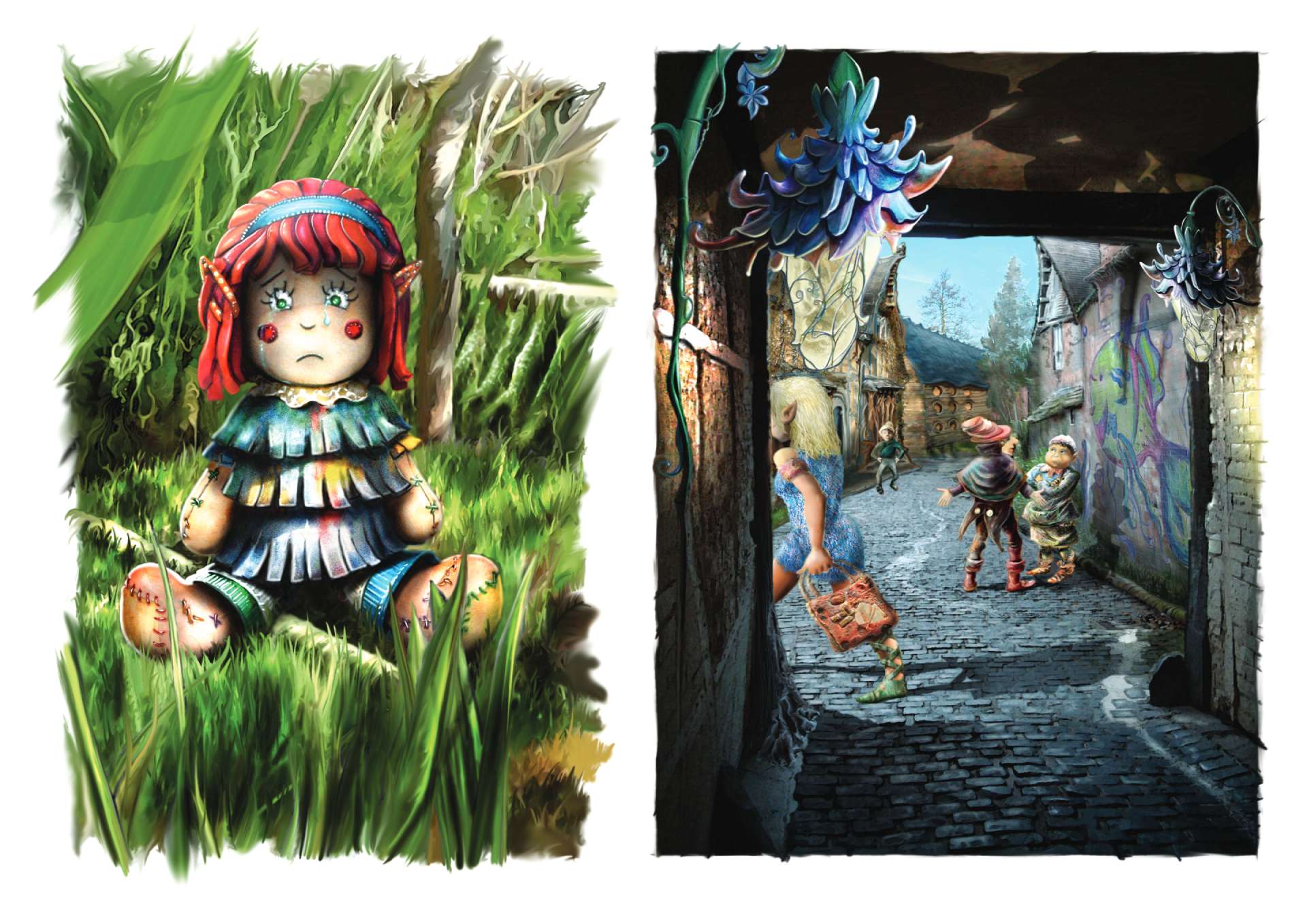
A child does not need every detail of a story to be contained in the words. The illustration can show the snow, the hill, the character’s expression, the joke, the danger or the surprise. The adult can talk about what is happening. The child can concentrate on the part that is theirs to do: reading the words.
The picture carries the story. The child carries the reading.

Why not just start with ordinary children’s books?
Of course children should be surrounded by rich language. They should be read stories they could not possibly read for themselves yet. They should hear words they do not know and encounter ideas beyond their present experience. But listening to a story and reading one independently, are different skills.
The problem comes when we assume that a book suitable for an adult to read to a child must also be suitable for that child to read alone. It doesn’t follow.
A first decoding book has a rather particular job. It needs to give the child enough material to practise reading, while still giving them the satisfaction of reaching the end of a real little story.
That last part matters because finishing a book is an achievement … however small the book may be.
Simple does not mean simplistic
There is sometimes an understandable fear that making early books easier means making them dull; it doesn’t have to.
A story can be visually rich, funny, surprising or slightly mysterious without requiring difficult vocabulary. The words and pictures simply have different jobs.
That is why our titles contain elves, snow, hills, mishaps, friendship and adventure alongside their surprisingly small vocabulary.
The constraint is on the decoding, not on the imagination.
A beginning, not a destination

Structured phonics teaching follows on from this beginning … because twenty-two sounds are not enough to read English.
Our story books’ work is to provide a beginning – where children discover that reading is something they can actually do for fun, rather than something that adults continually tell them they need to do. Once that confidence exists, their reading world becomes larger.
More letters.
More sounds.
More spelling patterns.
More complicated books.
Time to explore the upper floors that rise more steadily from their ground floor foundations.
What might the Year of Reading 2026 leave behind?
The useful legacy of the Year of Reading 2026 could be the simple question:
What can we do to make reading easier to begin?
Not easier by lowering expectations. Easier by removing unnecessary obstacles at the point where a child first encounters the written word.
That is the thinking behind the early readers from Little People Books. They are small A5 books. Yes, they are deliberately limited in their vocabulary, but they are intended to be complete stories – something a young child can work through with a parent or nursery leader then eventually recognise as something they have read themselves.
Try them. Click one or more titles below as they are available as free .pdf downloads. Make the ground floor a welcoming place.

Each title comes with guidance notes for parents and nursery leaders, helping you maximise the educational and joyful potential of these stories. Links and resources are included to explore phonemes, graphemes, and story-reading strategies.
Teachers’ Notes:
Within the 22-letter constraint
(A–Z minus Q, X, Y, Z)
and short vowels + hard consonants only
-
All words:
-
Decode left-to-right
-
Use short vowels only
-
Avoid blends, digraphs, silent letters, and irregulars
-
-
Safe for independent reading without adult help
-
Perfect base for:
-
LPB Early Readers (books)
-
Word cards
-
Posters
-
Floor games
-
Magnetic words
-
Story-making play
-

RED-LEVEL CORE VOCABULARY
(Restricted phoneme set – decoding only)
A
a
and
at
B
bad
bag
bat
bed
big
bit
box
C
can
cat
cot
cup
D
dad
den
did
dog
E
elf
end
F
fan
fat
fed
fit
fun
G
get
got
H
had
has
hat
him
his
hot
I
in
is
it
L
let
lid
lip
log
M
man
mat
men
mud
N
net
not
O
on
P
pan
pen
pot
R
red
rib
rod
run
S
sad
sat
sit
sun
T
tag
ten
tin
top
W
wet

LPB Early Readers
Teacher / Early-Years Notes
Why this vocabulary is deliberately restricted
The LPB Early Readers are designed for pre-school learners who are just beginning to recognise that marks on a page can be sounded out and read independently. To support this first, confidence-building step, the vocabulary is intentionally limited.
This is not a complete reading programme, nor a phonics course. It is a gentle entry point into reading, storytelling, and meaning-making.
1. Why only 22 letters are used
The RED-level vocabulary uses 22 letters of the alphabet, excluding Q, X, Y, and Z.
These letters are excluded because:
-
They are rare in everyday early language.
-
They often require positional or contextual rules to pronounce.
-
They can introduce confusion before children are ready to manage variation.
By removing them at this stage, children can focus on consistency: one letter, one sound.
2. Why only short vowels and hard consonants appear
All words use:
-
Short vowels (a, e, i, o, u)
-
Hard consonant sounds only
This ensures that:
-
Words can be decoded left to right, sound by sound.
-
There are no silent letters, softened sounds, or hidden rules.
-
Children can read without adult correction, which builds confidence.
3. Why blends, digraphs, and irregular words are excluded
You will not find:
-
Blends (st, bl, tr, etc.)
-
Digraphs (sh, th, ee, oo, etc.)
-
Irregular or “tricky” words (the, you, said, etc.)
These features are not avoided because they are unimportant, but because they belong to later stages of reading development. Introducing them too early shifts the experience from discovery to instruction.
LPB Early Readers aim to preserve the moment when a child realises:
“I can read this by myself.”
4. Why vocabulary is simple but not simplistic
Some words may feel more “adult” than expected (e.g. elf, mud, rib).
This is intentional:
-
Meaning can be carried by context and images, not just word familiarity.
-
Children enjoy learning new words when they can decode them successfully.
-
Story, humour, and emotion are preserved without increasing decoding difficulty.
5. Why repetition is encouraged
Words reappear frequently across texts and activities.
Repetition:
-
Reinforces pattern recognition
-
Builds fluency without drills
-
Allows children to experiment with rearranging words to create meaning
This supports emergent literacy, where reading grows through use, play, and confidence rather than testing.
6. How this fits alongside other reading schemes
LPB Early Readers are designed to:
-
Sit before formal phonics schemes
-
Complement, not compete with, structured reading programmes
-
Support language-rich play, storytelling, and environmental awareness
They are especially suited to:
-
Pre-school and nursery settings
-
Shared adult–child reading
-
Independent early reading moments
In short
The RED vocabulary is restricted by design, not by limitation.
It gives young learners:
-
Success without instruction
-
Reading without correction
-
Meaning without pressure
And it creates space for what matters most at this stage:
confidence, curiosity, and joy in reading.