


International Water Awareness Centre

The Benefits:
At WOW, our primary objective is to elevate awareness of the ubiquitous nature of water.
Central to this endeavor is our marketing aims, strategically designed to publicise our next mission of garnering support for the development of an International Water Awareness Corpus and over time, an International Water Awareness Centre for research, development and celebration of water’s ways.
“With various research facilities co-located on one campus, interdisciplinary collaboration becomes seamless. Scientists from different fields such as ecology, hydrology, , marine biology, and engineering can work together on projects that require diverse expertise”. (John C.Jones 2023)
 (above) John C. Jones Building (Image: World of Water Library)
Through exhibitions, displays, publications, events and talkabouts, World of Water are cultivating local and international support and contacts with a view to this ambitious vision– all in the pursuit of good planetary water stewardship.
When realised, research activities at the International Water Awareness Centre will highlight the multifaceted significance of water for visitors, and provide R&D facilities ranging from woodland and wetland carbon sinks to pioneering geoforming [terraforming] research labs.
As World of Water continue to showcase the breadth of water-related wonders, our aim remains on underlining the vital role water plays in our lives and environment, emphasizing the continuum from historical water use to contemporary and future applications.
As the Centre expands from its present blueprint stage, some of the diverse disciplines and facilities we already envisage as being required on site include:
🌐 a marine microalgae culture research facility
🌐 a blue-green bacteria study
🌐 an aquifer monitoring centre
🌐 space water research lab.
🌐 water data centre
🌐 water centre reception
🌐 coastal erosion and defence research
🌐 marine food tech centre and test menu cafe
🌐 water visitor centre
🌐 floating vegetable gardens (aquaponics/aquaculture)
🌐 woodland and wetland carbon sinks
🌐 geoforming research – exploring techniques to modify environments and create sustainable habitats / creation & maintaining atmospheres.
🌐 and maybe, for the young at heart, a Whirlpool Ride … mostly for venturi vortex hydroelectric generation trials 😉
By grouping water-related studies in this way within one centre, World of Water will open up a wealth of opportunities for interdisciplinary research, where experts from various fields work together to solve complex problems. This will be at the heart of our research centre as we culture ever greater collaboration and innovation.
For example:
- “We’ll monitor aquifers, the underground layers of water-bearing rock that supply our wells and springs, to better understand and manage these vital resources.”
- “The centre will explore aquaponics, a sustainable food production system that combines raising aquatic animals with cultivating plants in water.”
- “Our whirlpool ride will double as a research tool for venturi vortex hydroelectric generation, harnessing the power of water currents to produce clean energy.”
Here are some potential scientific studies that could be conducted:
Ecosystem Interactions:
Investigate the interconnectedness between woodland and wetland carbon sinks, aquatic ecosystems, and terrestrial habitats. Study how changes in one ecosystem affect the others and explore strategies for enhancing biodiversity and ecosystem resilience.
Community Engagement and Education:
The water visitor centre and test menu cafe can serve as platforms for community engagement and education. Visitors can learn about water conservation, sustainable agriculture, and ecosystem health through interactive exhibits, workshops, educational programs and on ‘Buckland Taster Days’.
 (above) Buckland Dome (below) Buckland Platform (Images: World of Water Library)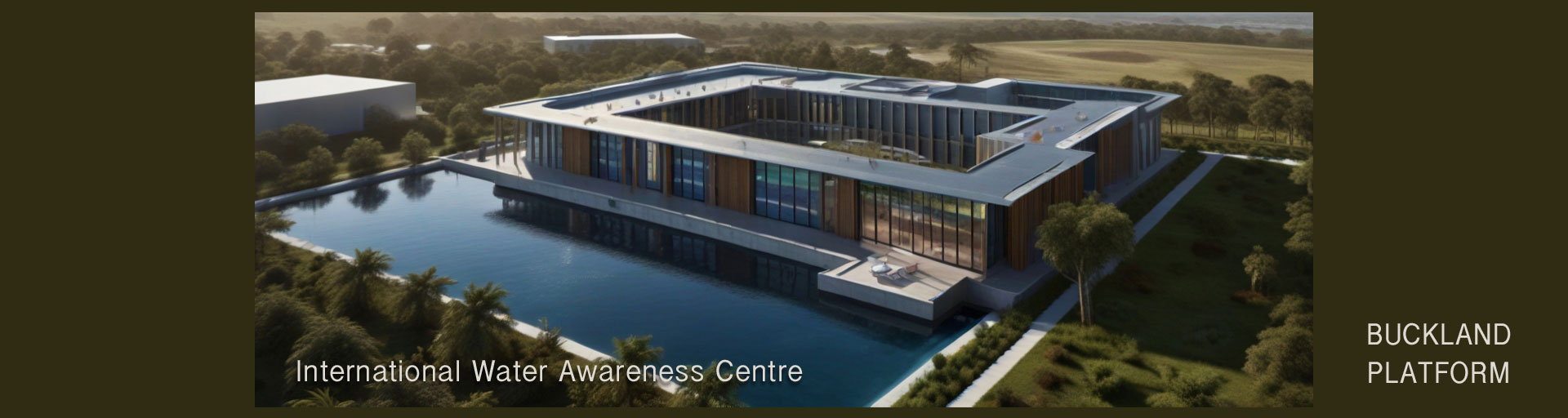
Climate Change Mitigation:
Use geoforming research labs to model novel techniques for carbon sequestration and soil creation as they may apply to various planetary conditions. Experiment with soil / carbon enhancement methods and evaluate their possible effectiveness in developing new atmospheres and mitigating future climate changes with the incorporation of paleontological observations.
Alternative Energy Sources:
Utilize the marine algae culture research facility to study production of microalgae and blue-green bacteria biomass, fed on re-purposed farm wastes presently lost along water courses through stormwater. Evaluate the feasibility of using more algae and/or bacteria based biofuels (Green Crude) as a sustainable alternative to fossil fuels and assess their potential environmental implications. Further Reading: BIQ House
Water Resource Management:
Establish the aquifer study centre to monitor changes to global groundwater levels, assess aquifer recharge rates, and develop sustainable groundwater management strategies. Investigate the impacts of climate change and human activities on aquifer dynamics and explore adaptive management approaches.
Space Exploration:
The space water lab can conduct experiments on water recycling and purification technologies for long-duration space missions. Investigate closed-loop food production systems and develop innovative methods for Earth sourced water reuse in space habitats and facilities for sampling and studying water samples sourced in Space. (Ref: Oceanworlds)
Data-driven Solutions:
Establish the water data centre as a hub for collating and analyzing hydrological data from various sources. Use advanced digital modeling techniques to predict water availability, identify vulnerable regions, and inform decision-making for water resource management and disaster preparedness.
Energy Generation:
Implement venturi aided vortex hydroelectric generation trials using the fun and educational visitor whirlpool ride to harness kinetic energy from water currents. Evaluate the efficiency and scalability of this innovative hydroelectric technology for low head-of-water sustainable power generation off grid.

Coastal Protection and Management:
Conduct research on coastal erosion and estuary sediment dynamics to inform coastal defense strategies. Use harbour defence research to explore natural and engineered solutions for mitigating coastal hazards and preserving and/or creating shoreline ecosystems.
Food Security and Sustainable Agriculture:
Utilize the marine food tech centre to develop aquaculture techniques for minimizing benthos disruption. Explore the integration of aquaponics systems with soil based agriculture to ensure global sustainable food production to keep up with changes to the size and demands of the world population.
Study historical and present day use of seawater and freshwater body fringes for floating soil media based vegetable gardens to enhance food security in flood zones and tidal areas.
“Worldwide research conducted on ancient aquaculture can provide critical insights into developing more ecologically sustainable, resilient, and diverse marine production systems for coastal communities today, thus, achieving industry sustainability and limiting negative environmental impacts to the world’s shorelines and overexploited fisheries.”[Ashleigh J. Rogers. April 2023]
Water Quality and Pollution Control:
The aquifer study centre and marine food tech centre can focus on monitoring water quality, identifying sources of pollution, and developing innovative technologies for water treatment and remediation. Researchers can explore natural filtration processes in wetlands and develop bio-inspired filtration systems.
Public Education and Outreach:
The water visitor centre will serve as an educational hub for raising and maintaining awareness about global research and study projects into water conservation, sustainability, and good environmental stewardship.
Engineering:
An engineering facility at the centre will design and make facilities for researchers and the interactive exhibits used in the guided tours and educational programs used to engage the public and inspire action towards a water-secure future.
🌐 By bringing together these diverse disciplines and research facilities in one Centre, we can foster collaboration, innovation, and synergies that accelerate scientific discovery and contribute to addressing pressing global challenges related to water security, climate change, and sustainable development.

Take Action for Water Awareness Today!
Join us in making a tangible impact on global water stewardship! Your support is crucial for the development of the International Water Awareness Centre, where innovation meets sustainability.
Here’s How You Can Help:
- Donate: Every contribution, big or small, fuels our research and educational initiatives.
- Get Involved: Become a volunteer or partner with us to amplify our mission and reach.
- Spread the Word: Share our vision with your network and help raise awareness about the importance of water conservation.
Together, we can create a sustainable future for our planet.
Please show your support straight away by sharing your hopes for your future, and that of your children with us on: X (Twitter) @Worldof_Water

Update ref: iwac/s